
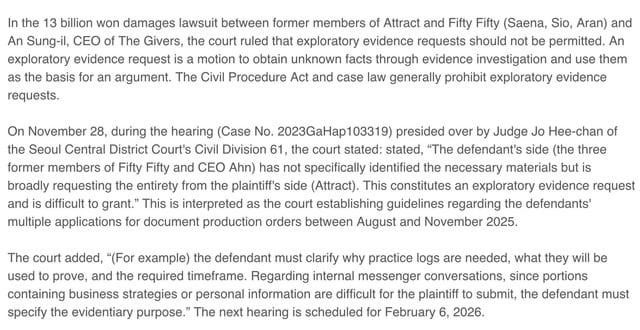
- The plaintiffs (Saena, Sio, Aran, and Ahn Sung-il) requested an excessive amount of documents from Attract.
However, these documents:
•The purpose for which they were requested is unclear,
•They are overly broad in scope (e.g., "all internal communications of the company, all strategy documents"),
•Their usefulness is unclear,
•They constitute requests for what is termed "exploratory evidence" in the law, meaning requests to find something by randomly searching through documents.
⚠️ Such broad document requests, akin to "fishing expeditions," are prohibited under Korean law.
- The court stated:
•"You are not clearly stating which document you want and why. Therefore, we are not accepting your requests."
In other words, the plaintiffs requested general things such as:
•"Provide all of Attract's internal messages."
•"Provide all company strategies."
The court, however, asked them to be more specific:
•Which conversation? When? For what evidence?
- The court also states the following:
•Attract cannot provide all of them because internal communications contain business strategies and personal information.
•Therefore, plaintiffs must clearly state exactly what they want and why.
•This is like a warning from the court to the plaintiffs:
•"I will not deal with unsubstantiated, broad, and vague requests. Clearly state what is truly necessary for the case."
📌What Does This Decision Mean?
In short:
✅ The court found the document requests from former Fifty Fifty members and Ahn to be very weak.
❌ It rejected requests along the lines of "Just give us all your documents, we'll find something."
⚠️ Plaintiffs must now prepare more concrete and evidence-based requests.
•This situation generally implies:
•The plaintiff's arguments may be considered weak.
•The court does not want to burden Attract with unnecessary paperwork.
•There is an implication that there is a gap in the plaintiffs' litigation strategy.
Next hearing:
📅 February 6, 2026